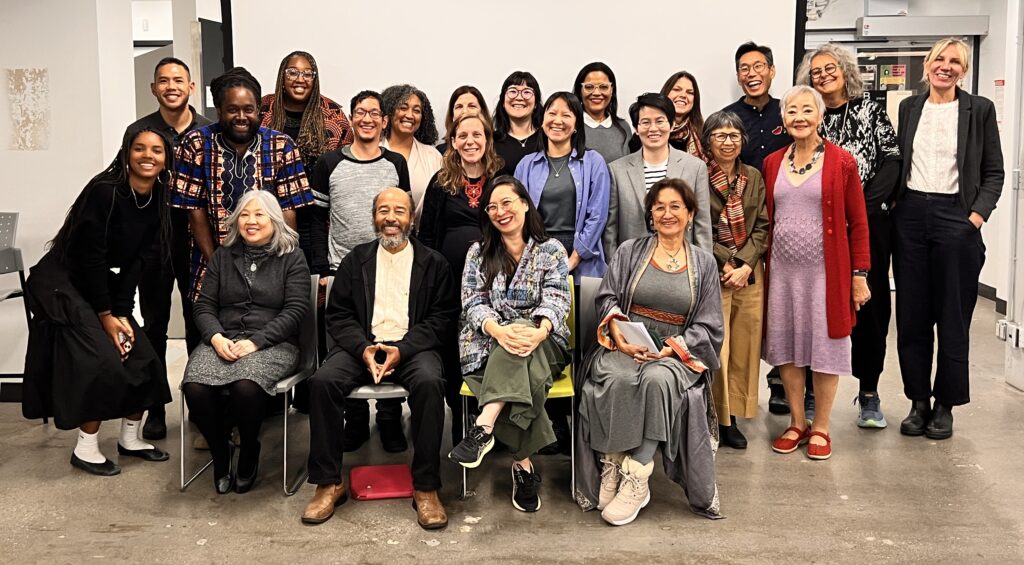
On October 16 and 17, 2025, the symposium
Surfacing: Chinese Caribbean Intellectual Thought and Creative Practice was held in Toronto, Canada.
The symposium was organized by the Chinese Caribbean Scholarship Network (CCSN) and held at the Rosalie Sharp Pavilion, OCAD University.
Richard Fung, Professor Emeritus at OCAD University invited me to this symposium, and he told me that he was interested in my journey in bringing visibility to a Chinese presence in Suriname as both an artist and the curator of the exhibition Hakka Opera in Suriname.
I would present in the Visual Arts panel together with Jeanette Kong (Jamaica/Canada), Mimian Hsu (Costa Rica) and Albert Chong (Jamaica/USA).
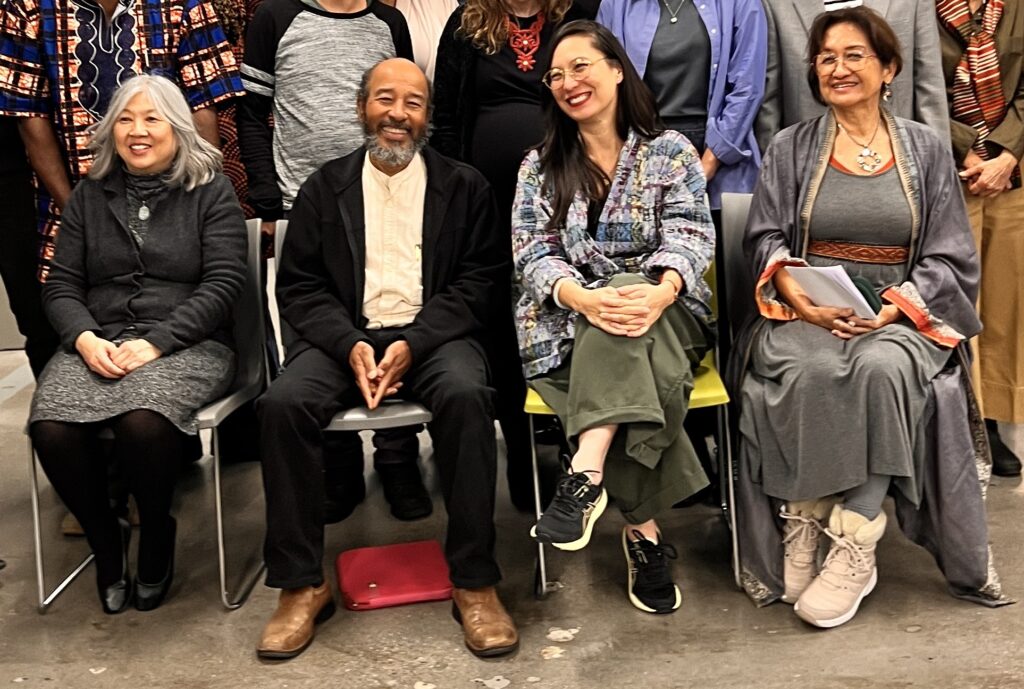
Crop of photo by Michael Lee Poy.
Although I am often introduced as a visual artist, writer, and curator, in fact, I am a multidisciplinary visual artist who loves to write and occasionally work as a curator.
Richard Fung’s question left me conflicted. Did I really bring visibility to a Chinese presence in Suriname as a visual artist, and how visible have I been as an artist in general? But I love challenges, so I accepted the invitation, and this is an excerpt of my story.
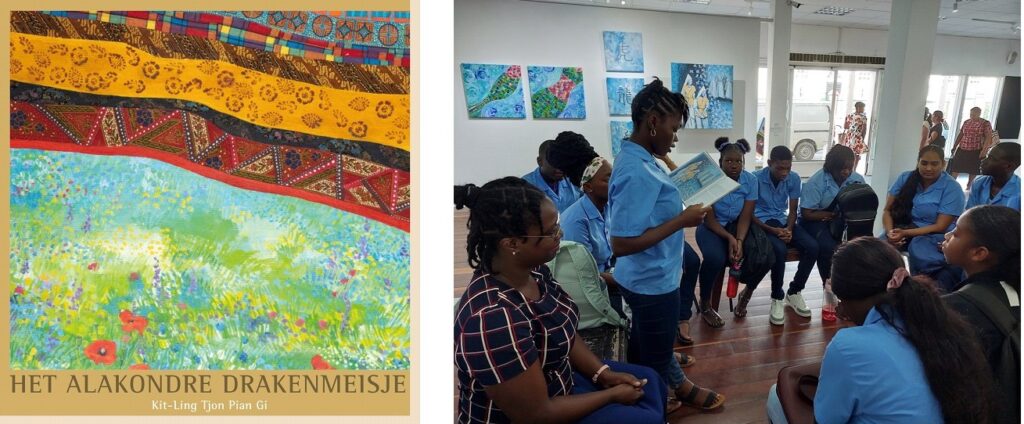
In 2022, my artbook and youth novel Het Alakondre Drakenmeisje was published together with my solo exhibition Alakondre Tori and an educational art and reading program for high school youngsters. The novel is about a girl who, in her years of adolescence, travels with a Khi Lin mask from Suriname to the Netherlands, then to China, and back to Suriname.
The concept had been brewing for about 12 to 15 years. I wanted to write a book with a narrative of the countries that shaped my life. I was born and raised in Suriname, and Chinese culture was instilled in me from birth, albeit intermingled with Creole culture. I was born Dutch, but in 1975, with the independence of Suriname, I became Surinamer, and for higher education, I studied in the Netherlands for several years. Three of my grandparents were Chinese, my maternal grandmother was a Chinese mulatto.
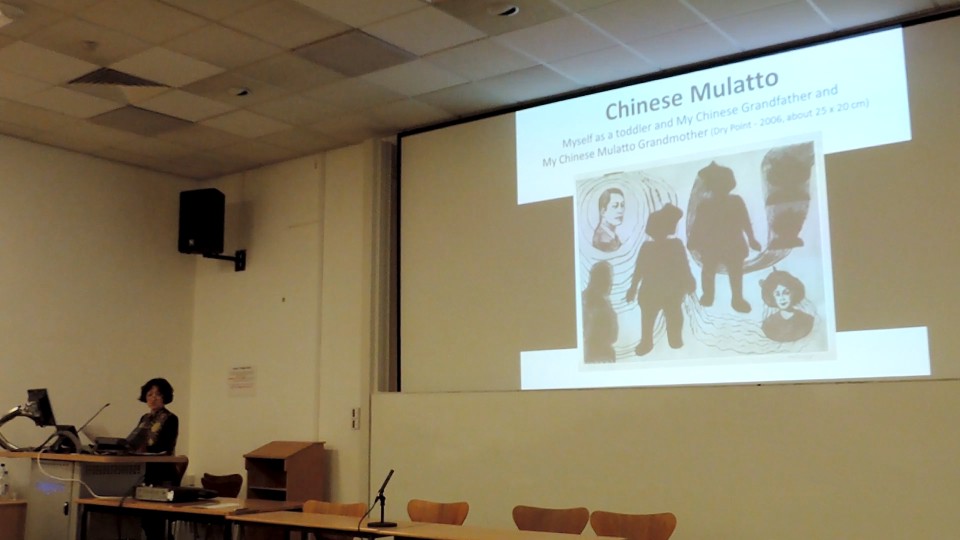
Annual Conference of the Association for Caribbean Studies in the UK in 2013.
Although I am almost 100% of Chinese descent, I did not know much about the country, so I started doing research and managed to have a third of the story take place in China. Due to covid, I could not visit the country, but I wanted to have the book published together with the accompanying exhibition. I wrote the China part of the story, thanks to three friends. One was a first-generation Chinese in Suriname, one was of the second generation, another had a master’s degree in Chinese studies, and last by not least, the Internet was very helpful. All three of my friends live in the Netherlands at the moment. Maybe because of the Chinese exposure I gave with the book and exhibition, I was asked to curate an exhibition on the commemoration of 170 years of Chinese immigration in Suriname.
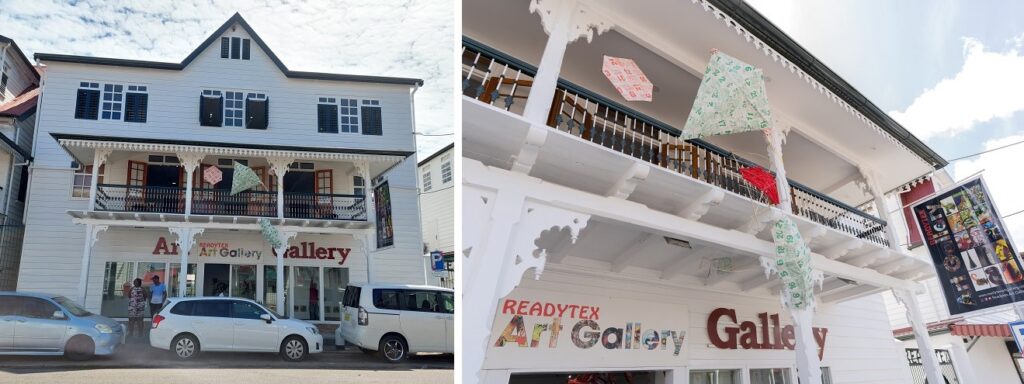
The exhibition was on display in Readytex Art Gallery. This gallery is located in a colonial building with four floors of exhibition space. The exhibition was named Hakka Opera in Suriname. In the concept, visual artists would tell the story about tradition and adaptation within a history of resilience. There were also three focal points in the concept of the exhibition.
- Inspired by the strong family bond in Hakka culture, the first focal point was to include all visual artists of the Readytex Art Gallery family.
- Just like in the Chinese Hakka opera, there had to be moments of silence and moments with a lot of movement.
- There had to be an interactive element in the exhibition.
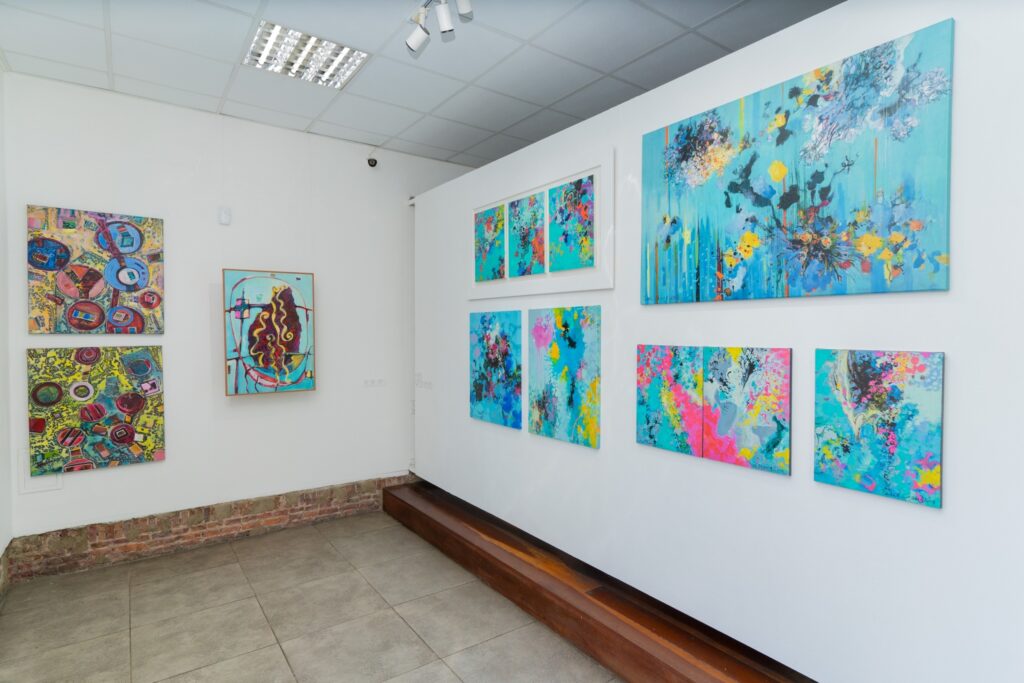
Ad.1. In some cases, the work was selected based on the clearly visible Chinese roots of the artist, but most of the work was selected because of its Chinese-looking appearance in its lines and rhythms. This might sound strange, but for instance, Rinaldo Klas traveled through China for about a month. His solo exhibition after this visit was inspired by China. Work of this solo exhibition was selected for the exhibition Hakka Opera in Suriname. The influence of the first Chinese immigrants on Surinamese culture went almost unnoticed, but it was always there. The Hakka have a tradition of migration, and from it they learned not to be overtly present and to adapt to their new environment. The first Chinese were Hakka Chinese men. There have always been many intermarriages or intersexual relationships with the local population, often long forgotten through the years and only DNA tests can tell. The Chinese had a big influence on the cuisine, but this seems mostly unknown nowadays. For instance: many Caribbean countries see chow min as a local dish, often without realizing its Chinese origin. In the rural district of Coronie, Suriname, the first Chinese immigrants built a big irrigation canal, and this district became famous for its preserved local fruits. This heritage is considered Creole.
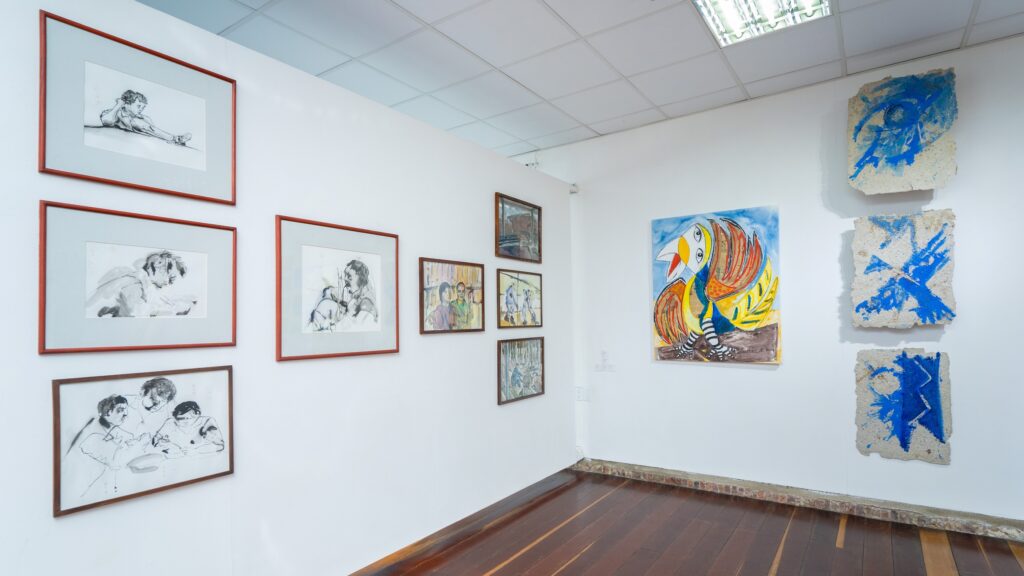
Painting by John Lie A Fo in the middle and Work of Miguel Keerveld at the right.
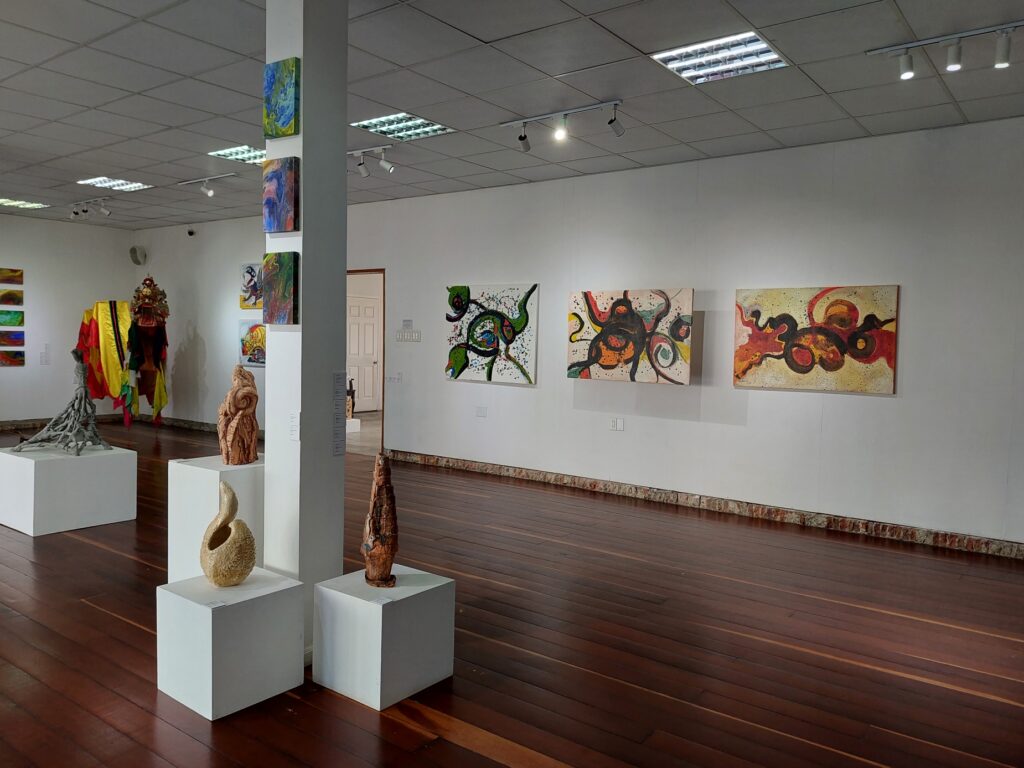
Ad.2. When I was doing research on the Chinese part for the book Het Alakondre Drakenmeisje, I discovered that, besides the well-known Peking opera, there was also a Hakka opera that was still popular within the Hakka communities until the previous century.
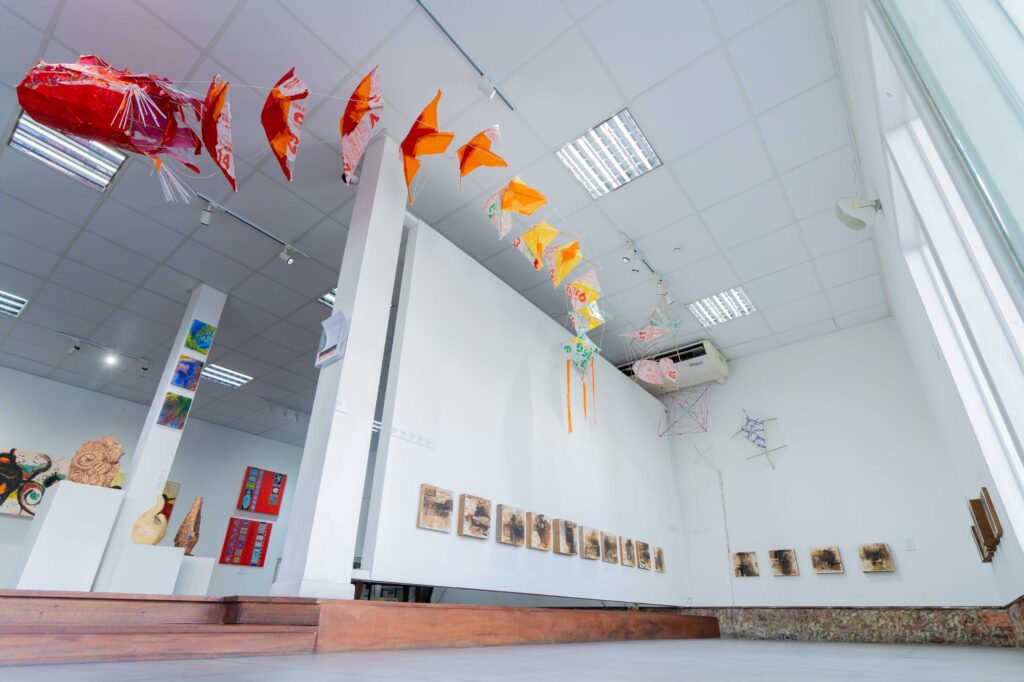
Ad.3. I wanted an interactive element in the exhibition. My parental family had a lot of photos of Chinese persons unknown to me. They may have been family and friends of my grandparents. As far as I could remember, there were quite a few Chinese photo studios in Paramaribo when I was a child and, so, I got the idea of making an installation of a Chinese photo studio. A Khi Lin mask was also borrowed from the oldest Chinese association. The Khi Lin dance is an old Hakka tradition and, nowadays, quite unique.
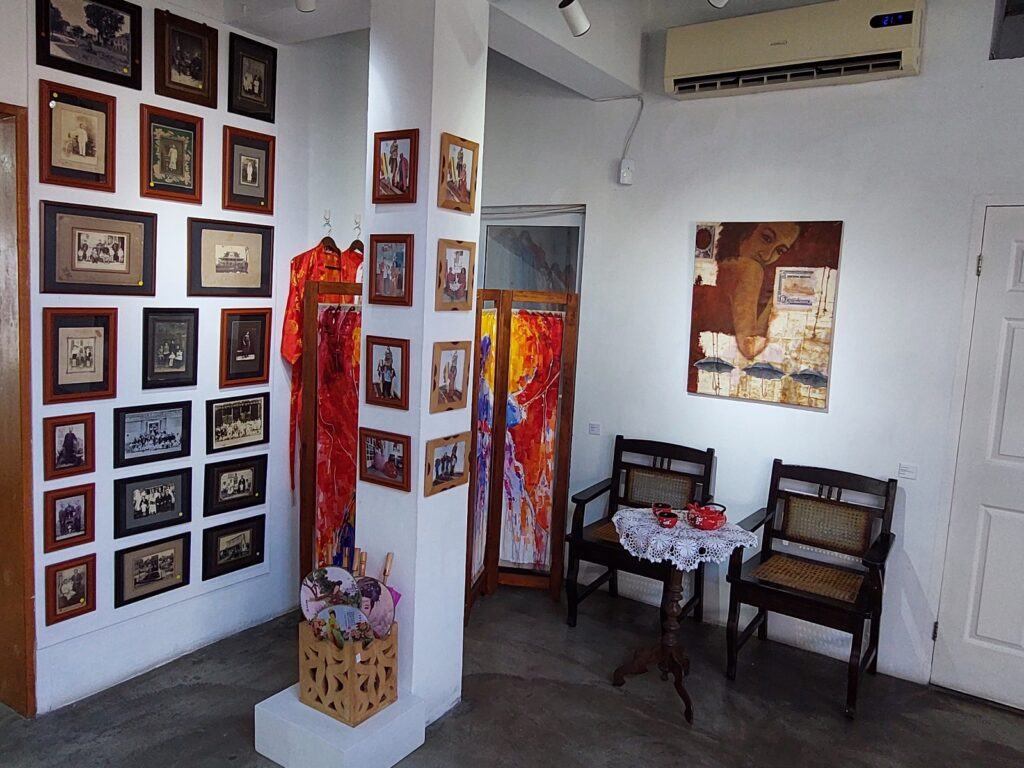
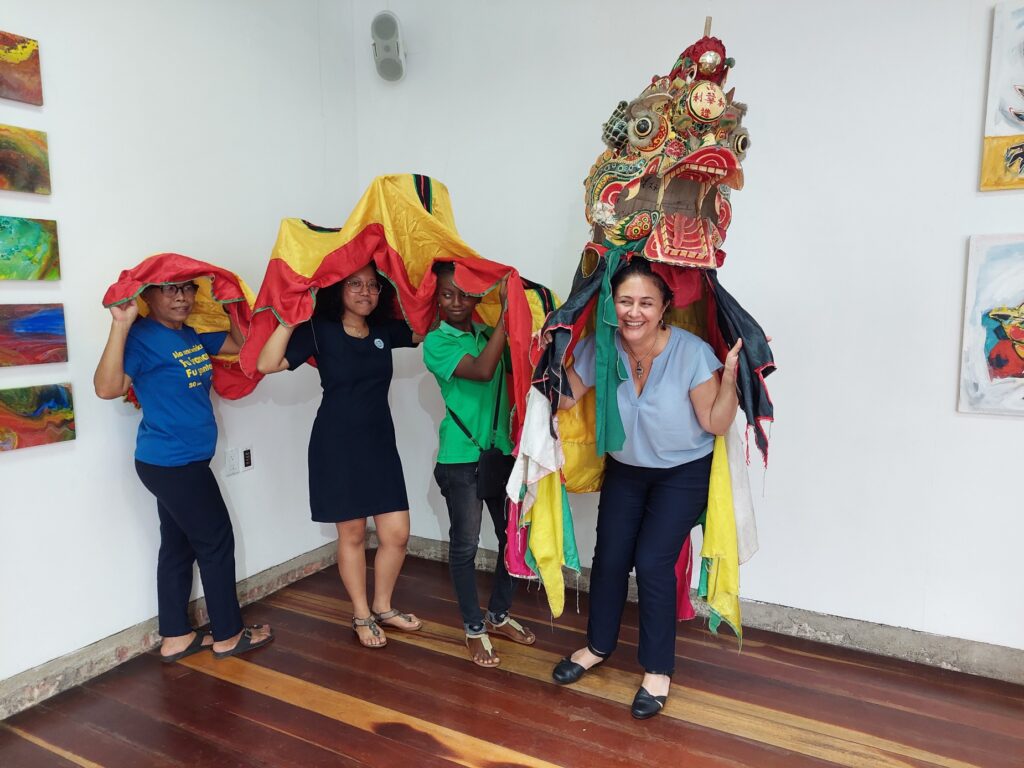
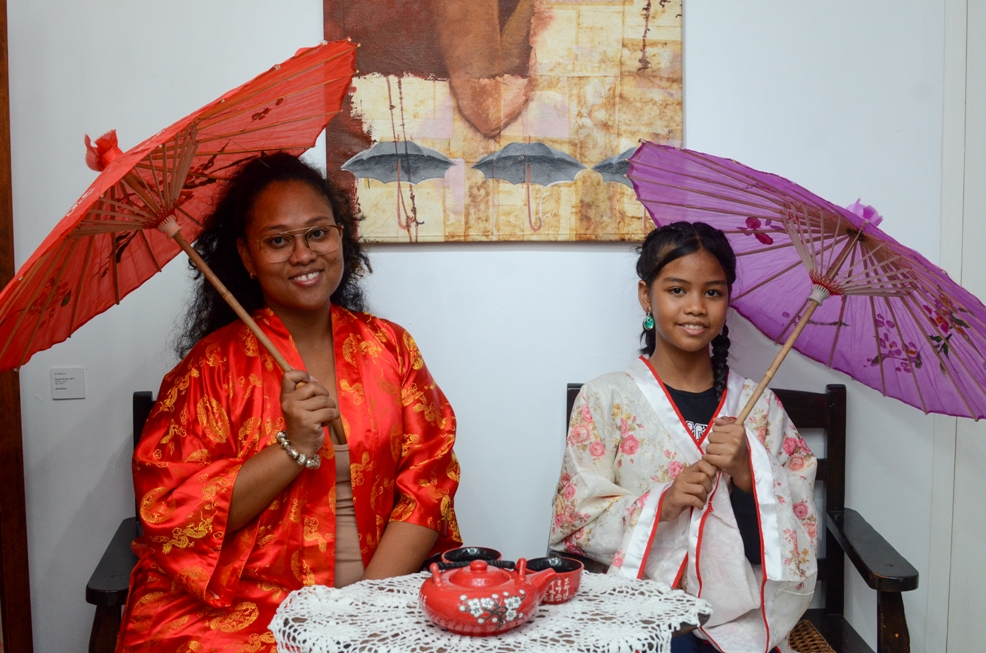
The interactive photo studio and the Khi Lin were very popular. They were both a big success.
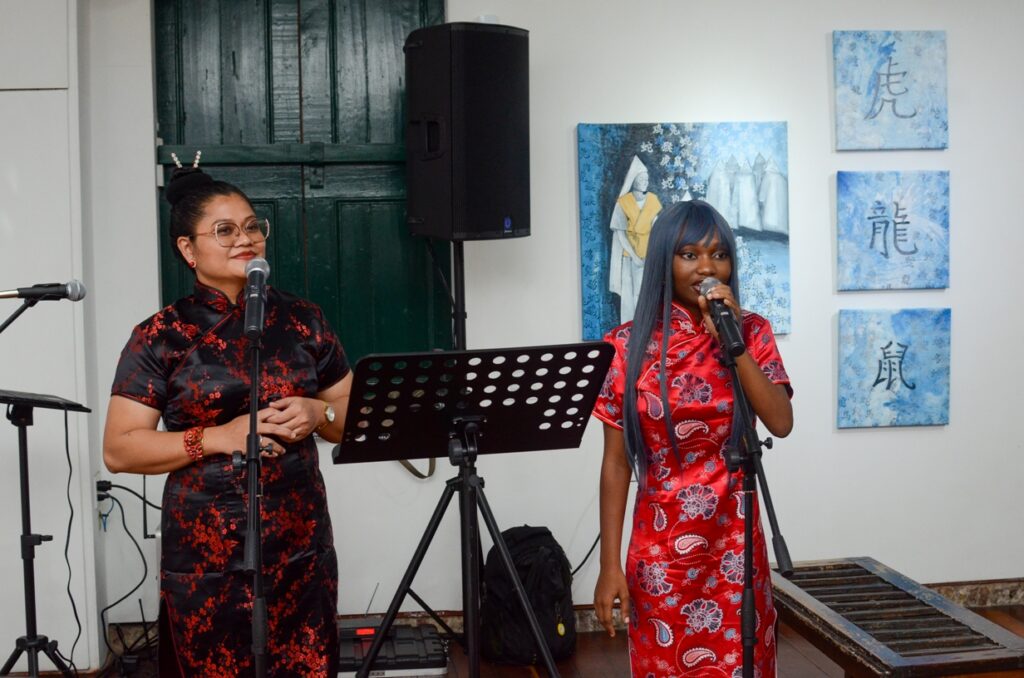
Museum Night was on October 14, and the gallery organized an event in collaboration with a new and active Chinese society. There was no Khi Lin dancer available and only Lion dances were performed. On October 20, however, the Chinese community suddenly found one Khi Lin dancer for the parade and, at their event at the Surinaams Museum, it was also possible to dress up in Chinese costumes and take photos.
The blood remembers is the title of a documentary Jeanette Kong made of Peter Chin. Chin is a highly regarded, multiple award-winning choreographer, dancer, filmmaker, composer, and musician of Hakka Chinese, Irish, and African ancestry who was born in Kingston, Jamaica.
It is a pity I could not see this 30-minute documentary, but only the trailer.
This trailer was enough to feel connected to Peter Chin. Because in search of an answer to the question “How visible was my Chinese identity as an artist?”, I could not always give a direct and clear answer. In an interview at the screening of the film at the Tsung Tsin Association of Ontario, Peter Chin said that, to him, seeing the film was like a revelation about himself. This is similar to the experiences I went through in a time span of several years.
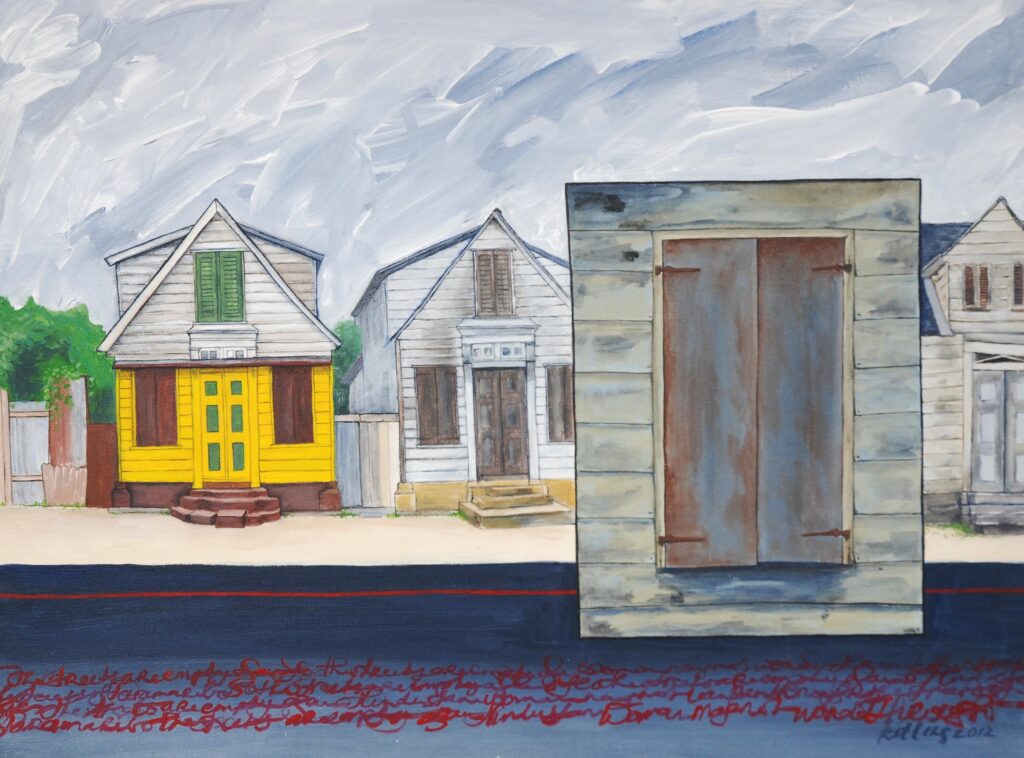
For a long time, I thought I was just a Surinamese girl, but about 35 years ago, I saw an exhibition of contemporary Chinese artists, and I realized that I was more Chinese than I thought. However, it was more a kind of intuition than the possibility to pinpoint evidence. I started analyzing my work and realized that, for instance, I loved to write poems in my paintings. Just like the ancient Chinese!
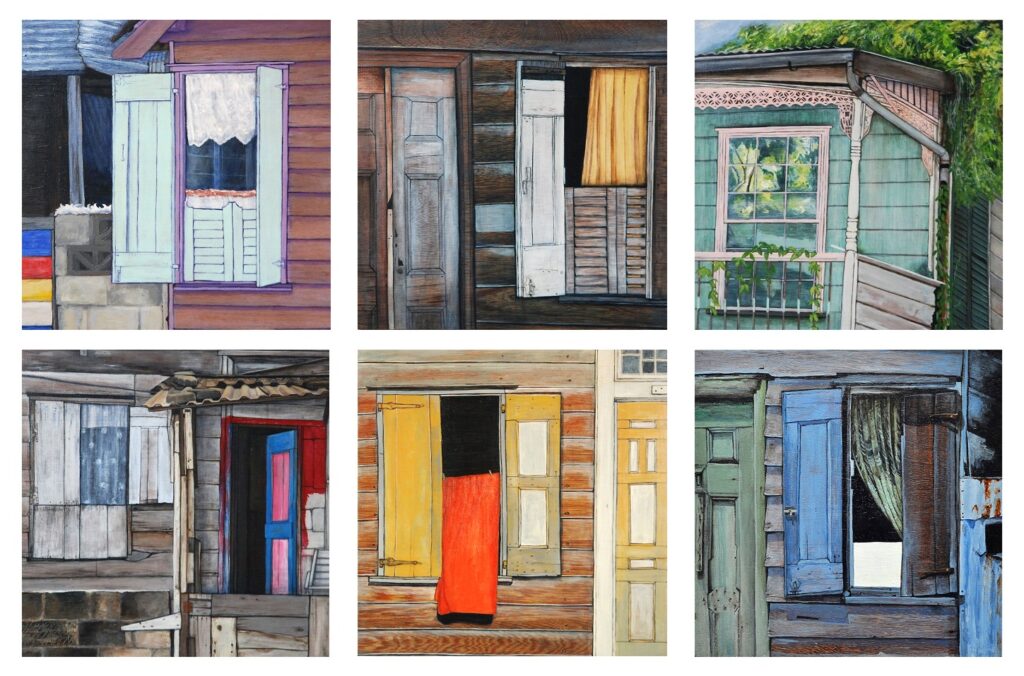
Another example that was more based on intuition and a particularly developed way of looking and seeing was expressed by a Chinese art professor and painter who visited Suriname. He saw a series of my paintings of wooden windows of wooden houses painted on wooden panels, and he said that he could see that these were painted by a Chinese.
During my career as an artist, there were only two concepts in which I deliberately chose to expose my Chinese-ness.
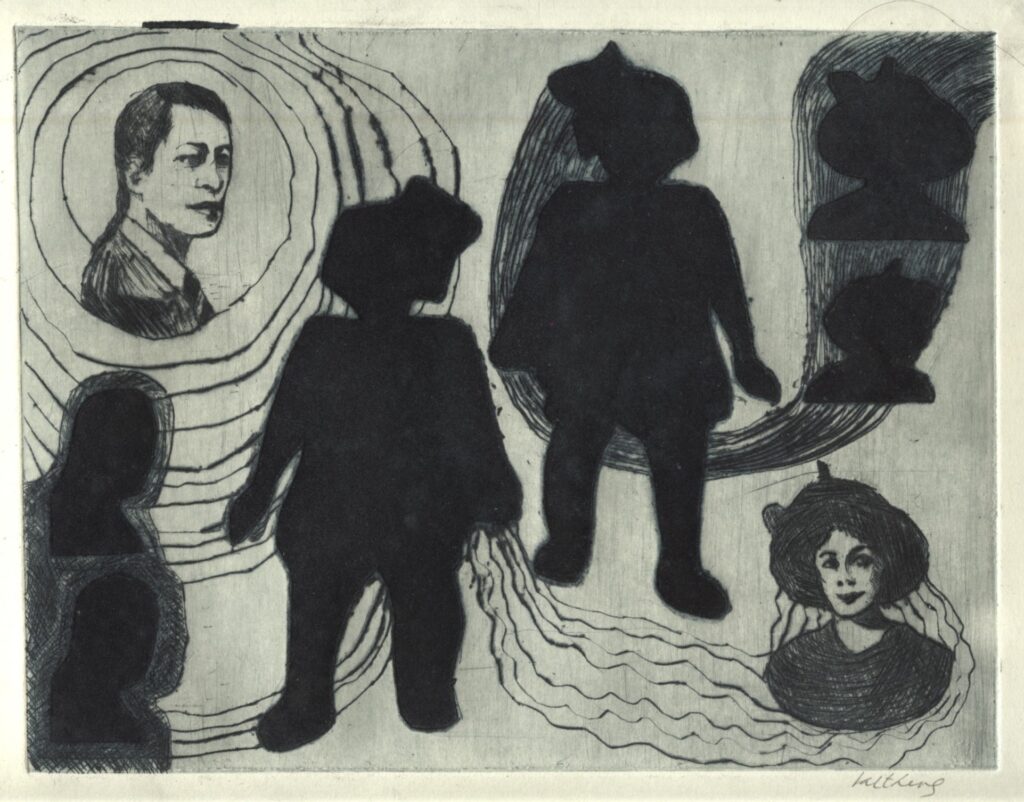
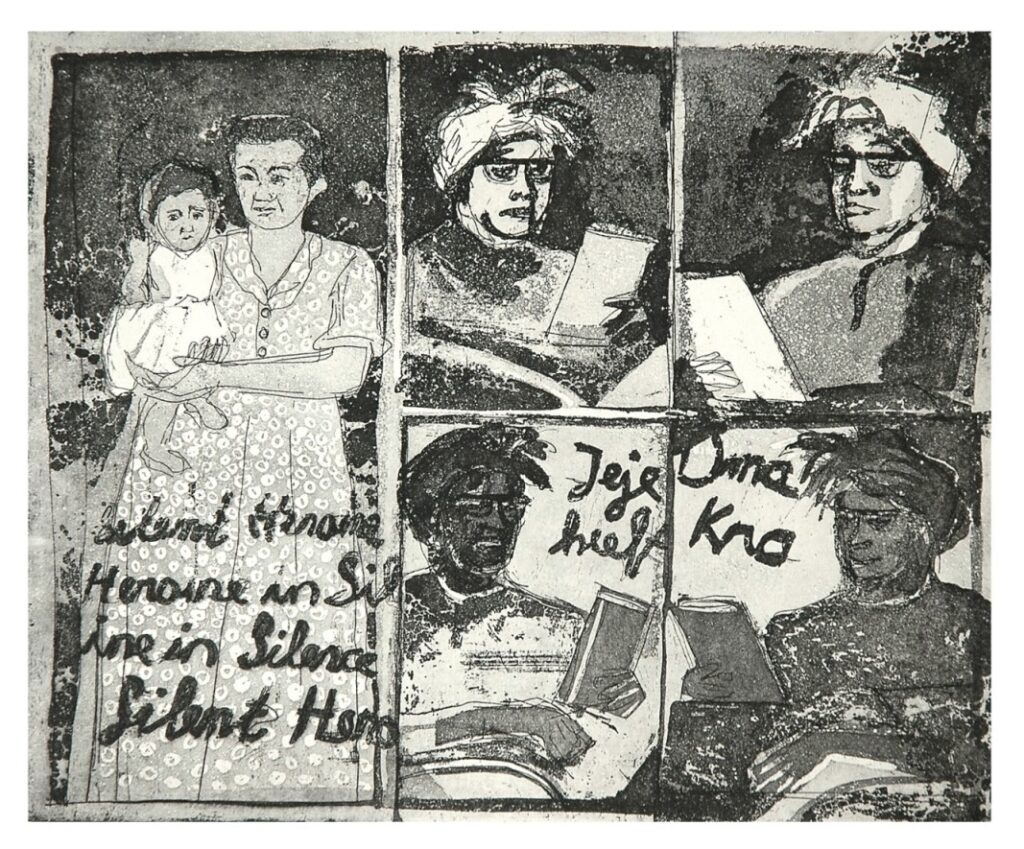
and the Surinamese icon, writer and poet Johanna Schouten – Elsenhout.)
In 2006, there was an exchange project between the FVAS, Federation of Visual Artists in Suriname, and ‘Het Amsterdams Grafisch Atelier’. One of the visiting artists proposed to share a common theme. And the theme was “Heroes”. At that time, most of the acknowledged heroes in Suriname were of Creole or African descent. I decided that my grandparents were my heroes: My first generation Chinese Apoh and Akoeng (parental grandparents), and my Chinese mulatto Tjapo (maternal grandmother).
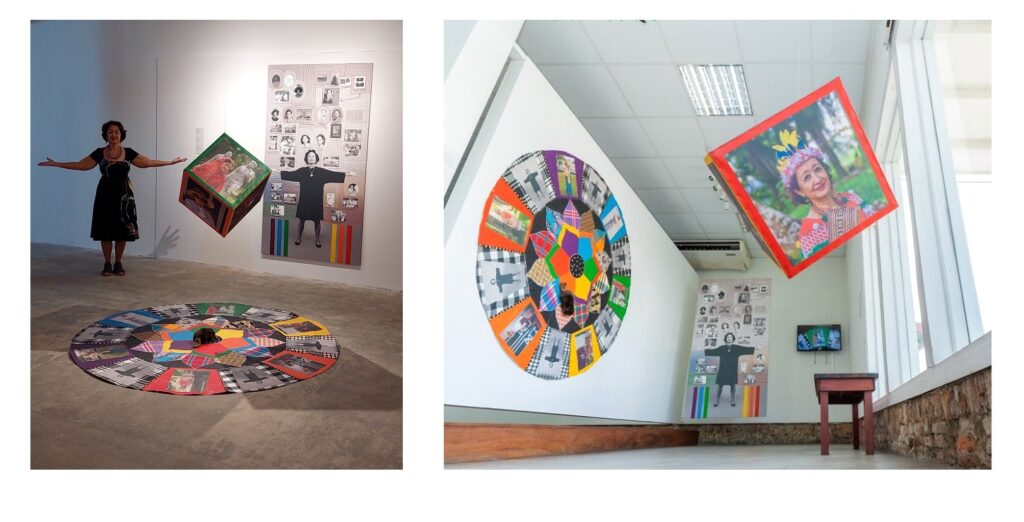
Around 2018, Alakondre philosopher Alida Neslo, and our gallerist Monique Nouh Chaia, challenged us as visual artists to carry out a project involving in-depth research into all aspects of Alakondre. In 2021, I made the installation “My Alakondre Self-Portrait”. This installation is about my genealogy and my position in multicultural and intercultural Suriname. In this installation, I depict myself wearing my Apoh’s long black shirt but also costumes of different ethnicities.
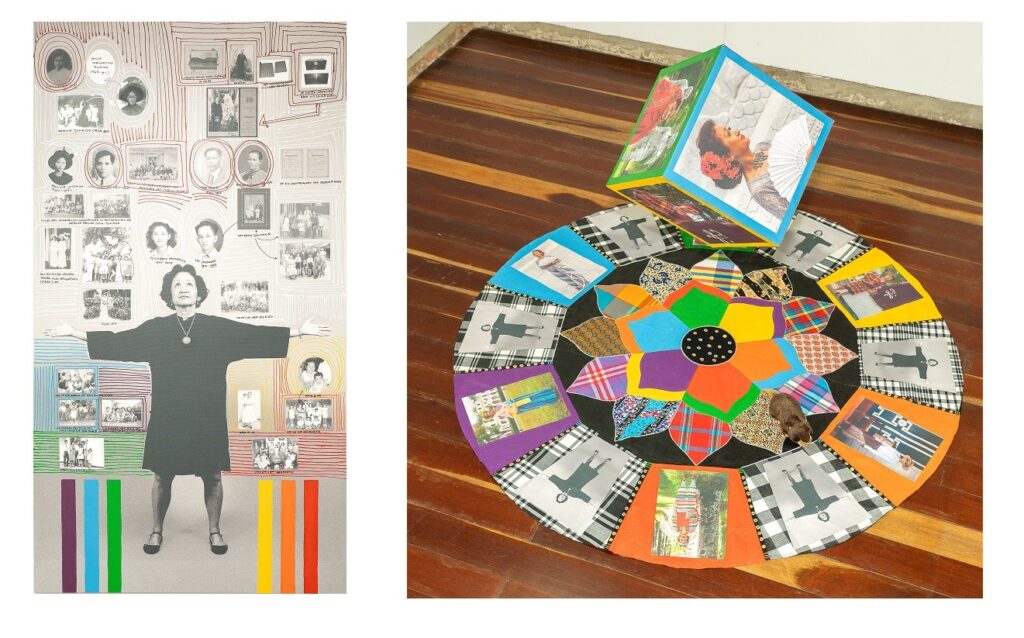
Born and raised in a Dutch colony, the Dutch culture was, in general, the ruling culture within multicultural and intercultural Suriname. But in the years preceding the independence in 1975, Suriname had some great thinkers, and with their quotes: “So many leaves but one tree” (Dobru), and “Unity in diversity” (Jhan Adhin), they urged us to embrace our own diverse cultures and to be proud of our diversity as one Suriname.
Furthermore, despite my mother being 75% Chinese, to her, the Chinese civilization was the greatest in the world. She instilled in us (her children) from birth, to be proud to be Chinese and I am, even with my Dutch education. And I am also proud to be Alakondre, and as such, I am able to see things from many perspectives.
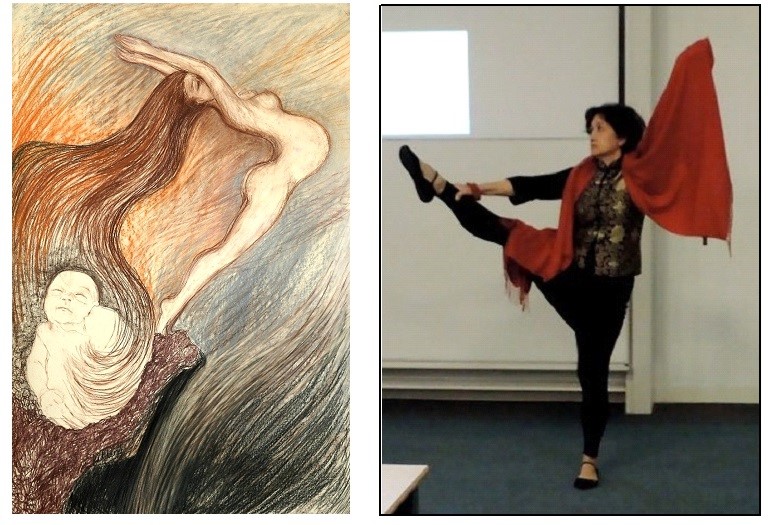
Still of the video made of my performance during the Bridget Jones presentation 2013
I closed my presentation with the question “How visible could I have been?”, together with several statements of which I mention only three in this blog.
- I was born into a time when the contemporary art world was dominated by upper-class white men, and women of color were largely invisible.
- The African continent and its diaspora have been asserting their place for more than half a century now. Only recently Asians began to rise and claim their space as well.
- I chose not to live and work in a global city, but in a developing country with about 600.000 inhabitants. So, have I been visible in only a very small circle?
Looking back on my experience at the symposium, I can say:
The symposium was small, intimate and inspiring with a feeling of all belonging to one family of extraordinary and wonderful people.